How direction, light, and spatial order in your workspace can quietly support focus, funding, and a team that actually wants to show up.
A startup runs on energy — long hours, hard decisions, and the constant push to grow. Vastu is not about superstition; it is about arranging that environment so it works with you instead of against you.
Most founders obsess over product, hiring, and runway, and ignore the room they spend twelve hours a day inside. Yet the workspace shapes how clearly you think, how a pitch lands, and whether your team feels drained or driven. Vastu Shastra — the ancient Indian science of space, direction, and natural elements — offers a practical framework for that environment, whether you own a floor or rent a single hot-desk.
This guide translates classical Vastu into decisions a founder can actually make today: where to sit, where the door belongs, which corner holds the money, and how to apply all of it inside a co-working space you don’t control.
Why Vastu Matters More for Startups
Established companies have inertia — brand, capital, and momentum that carry them through a badly arranged office. Startups have none of that cushion. Every advantage is marginal and every drag compounds. A workspace that fights your focus, scatters your team's attention, or feels heavy to investors is a tax you pay daily.
Vastu addresses the controllables: natural light, air movement, seating direction, and the psychological order of a space. Get these right and you remove friction. The benefit is rarely mystical — it is a calmer mind, sharper meetings, and a room that feels like momentum.
Where the Founder Should Sit
The most important seat in any company is the founder’s, and Vastu is specific about it. The south-west is the zone of stability, authority, and long-term grounding — exactly what a leader carrying the company’s weight needs.
Founder & Leadership Placement
Sit in the south-west corner of the office, with a solid wall behind you for support, and face north (the direction of wealth and flow) or east (clarity, new ideas, fresh starts). Avoid sitting with your back to a door or window, which Vastu reads as instability — and which genuinely keeps you subtly on edge.
The Entrance & First Impression
In Vastu, the main door is the mouth of energy — the point through which opportunity, clients, and capital enter. For a growth-stage business, this matters twice over, because the entrance is also the first thing an investor or client sees.
Entrance & Reception
North, east, and north-east entrances are the most favourable, inviting opportunity and forward momentum. Keep the doorway well-lit, free of clutter and broken fixtures, and give the approach a clean, confident feel. The reception or first impression zone works best in the north or east, with the company name visible and the space bright rather than cramped.
Mapping Your Office Into Energy Zones
Vastu divides any space into directional zones, each suited to a function. You don’t need a large office to apply this — even a two-room setup benefits from putting the right activity in the right corner.
Function-by-Direction Map
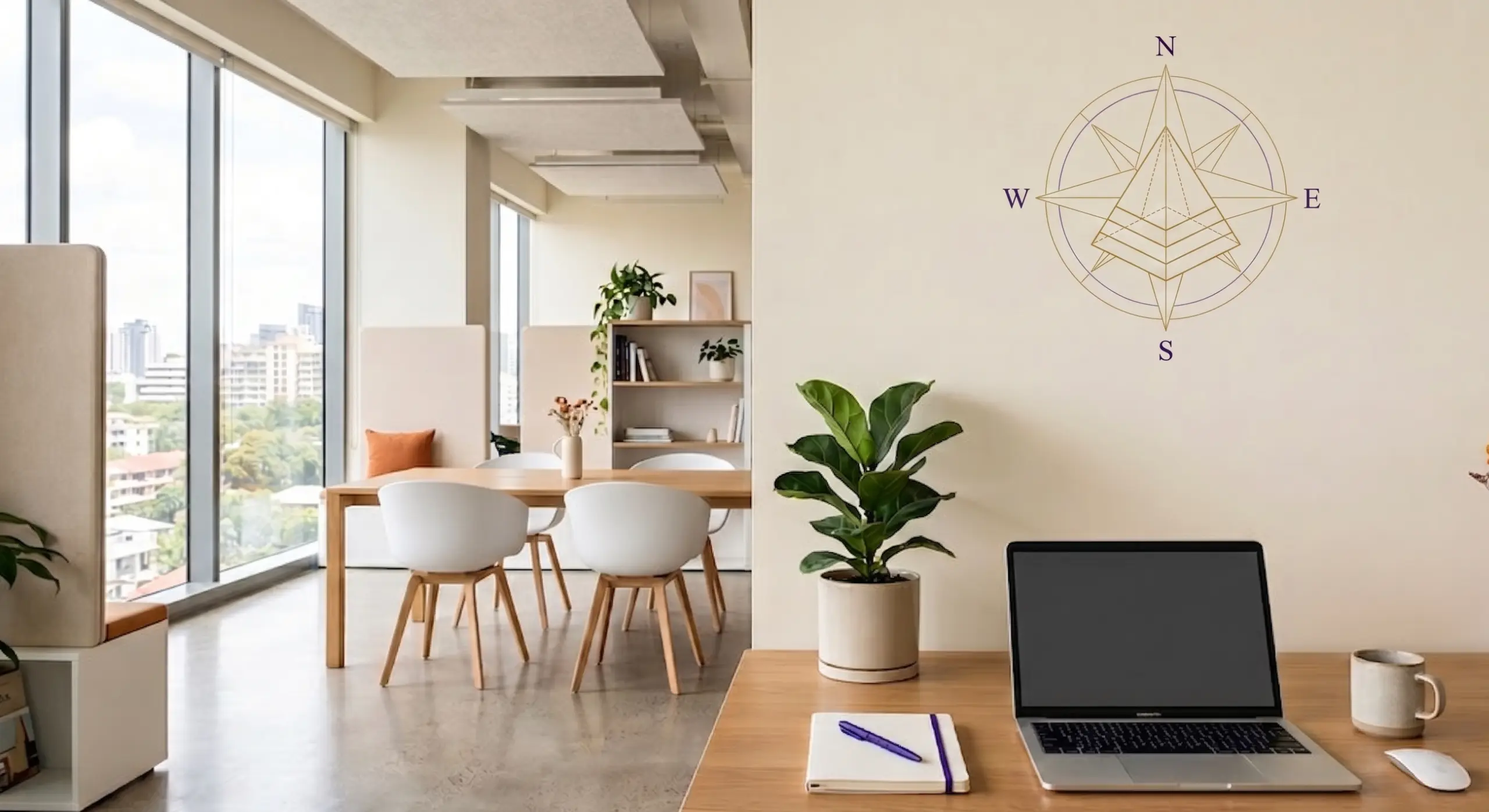
North & north-east — finance, accounts, and the quiet/think zone; this is the wealth and clarity quarter. East — collaboration, marketing, and creative teams who thrive on fresh-start energy. South-east — the fire corner, ideal for servers, electrical, and the kitchen/pantry. South-west — leadership, heavy storage, and stability. North-west — sales, logistics, and anything that benefits from movement and quick turnover. Keep the centre (Brahmasthan) open and uncluttered; it is the breathing space of the office.
A startup's office should feel like it is leaning forward — toward light, toward the door, toward what's next.
Vastu Inside a Co-Working Space
Here’s the honest tension: you rent a fixed desk and cannot move walls, choose the entrance, or pick your corner. Good news — most of Vastu’s practical benefit comes from things you can still control.
The Renter's Playbook
Control your facing direction first — angle your chair so you look north or east, even slightly. Keep your laptop and primary work toward the north or east of your desk, and your phone/devices in the south-east. Add a small source of light or a healthy plant to your left-front. Clear the desk at day's end; clutter is the one defect that follows you everywhere. If you get to choose a desk, pick one with a wall or stable partition behind you and a clear sightline to the room's entrance.
Energy for the Team
A startup lives or dies by its team’s stamina. Vastu’s environmental logic — light, air, openness, and order — maps almost directly onto what behavioural research already says about productive workspaces.
Workspace Wellbeing
Seat developers and deep-focus roles facing north or east, away from the highest-traffic walkways. Maximise natural light from the north and east — it lifts mood and reduces fatigue. Keep meeting rooms in the north-west or west, where decisions get made and movement is welcome. Ensure the pantry has its own (south-east) zone so food energy doesn't bleed into focus areas. And protect the centre of the floor as open, walkable space — a cramped middle makes a whole office feel stuck.
Quick Remedies When the Layout Is Fixed
Practical Corrections
When you can't change structure, you balance it. Use light to energise a dull corner, mirrors thoughtfully to extend cramped space (never facing the entrance directly), plants in the east and north to soften and refresh, and colour — soft greens and blues for focus zones, warm tones for collaboration areas. Most importantly, fix what's broken: a flickering light, a jammed drawer, a dead plant. Decay in a workspace is the defect Vastu warns about most, and the one people feel without naming.
Frequently Asked Questions
Which direction should a founder or CEO face while working?
Sit in the south-west of the office and face north or east. The south-west corner offers stability and authority; facing north supports cash flow, and facing east supports clarity and fresh ideas.
Is Vastu practical for a rented co-working desk?
Yes. Even with a fixed desk you control your facing direction, the placement of your laptop and phone, the lighting around you, and your desk clutter. These micro-adjustments deliver most of the practical benefit without any structural change.
Where should the main entrance of a startup office be?
North, east, and north-east entrances are most favourable for growth-stage businesses. If your entrance falls elsewhere, remedies such as lighting, signage placement, and a clear, welcoming approach help balance the energy.
Does Vastu actually affect business funding and growth?
Vastu is a design philosophy about light, direction, air flow, and spatial order. A well-arranged workspace reduces friction, improves focus and mood, and signals professionalism — all of which indirectly support growth. Treat it as one input alongside strategy and execution, not a replacement for them.
Set Up Your Office for Growth
Get a professional Vastu assessment of your startup or co-working setup — desk-level guidance for founders, or a full floor plan review for a new office.
Book a Consultation